
What is OEM and ODM in Towel Manufacturing?
| OEM (Original Equipment Manufacturing) | ODM (Original Design Manufacturing) |
| – OEM refers to a manufacturing model where the customer provides the complete design, technical specifications, and standards, and the factory produces towels strictly according to those requirements.
– In OEM towel manufacturing, the brand owner controls: + Product Design Specifications |
– ODM is a manufacturing model where the factory takes responsibility for product design and development based on the customer’s basic ideas or functional needs.
– The customer typically customizes: |
OEM vs ODM: Process Flow Comparison |
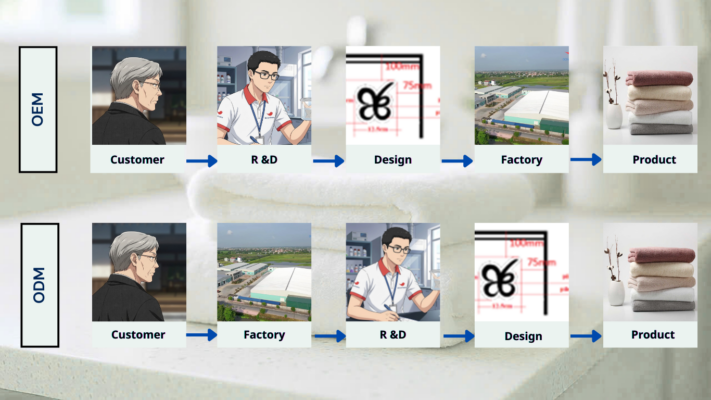 |
⟶ The key difference lies in who owns the design and development stage
OEM & ODM Towels: Side-by-Side Comparison |
| Criteria | OEM Towels | ODM Towels | ||||||
| Design ownership | Customer | Factory (customizable) | ||||||
| R&D responsibility | Customer | Factory | ||||||
| Customization level | Full customization | Moderate customization | ||||||
| Time to market | Slower | Faster | ||||||
| Development cost | Higher | More cost-efficient |
Which Model Should You Choose?When choosing between OEM and ODM towel manufacturing, buyers should evaluate their priorities: |
| Budget | Brand Vision | Speed to Market | Quality Control |
|
– ODM requires a lower upfront investment and is suitable for brands with limited budgets. – OEM, in contrast, involves higher development and setup costs. |
– For premium brands, OEM is the ideal choice to create unique towel designs that fully reflect brand identity. – ODM works well for brands focusing on value, efficiency, and proven designs. |
– By leveraging ready-made designs, ODM significantly shortens lead time and enables faster product launches. – OEM, however, requires longer development cycles due to customization and approval processes. |
– With OEM, brands maintain greater control over technical details and quality standards. – ODM relies on the factory’s established quality systems and existing standards. |
Practical Recommendations |
– Mid-range home towels and hotel towels: ODM is recommended to balance cost, quality and development speed
– High-end home towels and hotel towels: OEM is preferred for brands that require distinctive designs, long wash life and strict quality control.
Frequently Asked Questions (FAQ) |
| What is the main difference between OEM and ODM towels? | Is ODM towel manufacturing suitable for private label brands? | Which model is better for hotel towels, OEM or ODM? | Does ODM mean lower quality than OEM? | How should buyers choose between OEM and ODM towel manufacturing? |
| The main difference lies in design ownership and development responsibility. In OEM towel manufacturing, the buyer provides complete designs and specifications, while in ODM, the factory develops the design based on the buyer’s basic requirements. | Yes. ODM towel is highly suitable for private label towel brands because it reduces development cost, shortens time to market, and allows customization of branding, colors and packaging without requiring in-house R&D. | Both models can work for hotel towels. OEM is preferred for premium hotels requiring strict durability and wash-life standards, while ODM suits mid-range hotels seeking reliable quality with faster delivery and lower development cost. | Not necessarily. ODM towels can achieve high quality if the factory uses appropriate yarns, weaving structures, and finishing processes. The difference is control level, not inherent quality. | Buyer should consider their budget, brand positioning, time-to-market requirements, and quality control needs. ODM is ideal for speed and efficiency, while OEM is best for brands seeking maximum differentiation. |
Conclusion |
– Both OEM and ODM towel manufacturing models have clear advantages. ODM is ideal for brands seeking speed, cost efficiency and lower risk, while OEM suits brands aiming for maximum differentiation and full control over product quality.
– Choosing the right model depends on your budget, brand positioning and long-term strategy.